





 Google AI
 ChatGPT
 Perplexity
 Groq
If you are planning to study, work, or settle abroad in 2026, you already know that proving your English proficiency is a non-negotiable step in the process. For years, the International English Language Testing System (IELTS) and the Pearson Test of English (PTE) have been the two giants in this space.
As an instructor who has guided thousands of students through the complex web of visa applications and language tests, I often hear the same panicked question: "Which test is easier?"
The truth is, neither test is inherently easier. They simply test your English in different ways. However, what has changed significantly in 2026 is how various governments view these tests. Immigration policies in Canada, Australia, and the United Kingdom have undergone major updates. Choosing the wrong test, or the wrong version of a test, can lead to a rejected visa application and months of wasted time.
This guide will walk you through the precise differences between IELTS and PTE in 2026, specifically focusing on how they align with the latest immigration requirements for the top three English-speaking destinations.
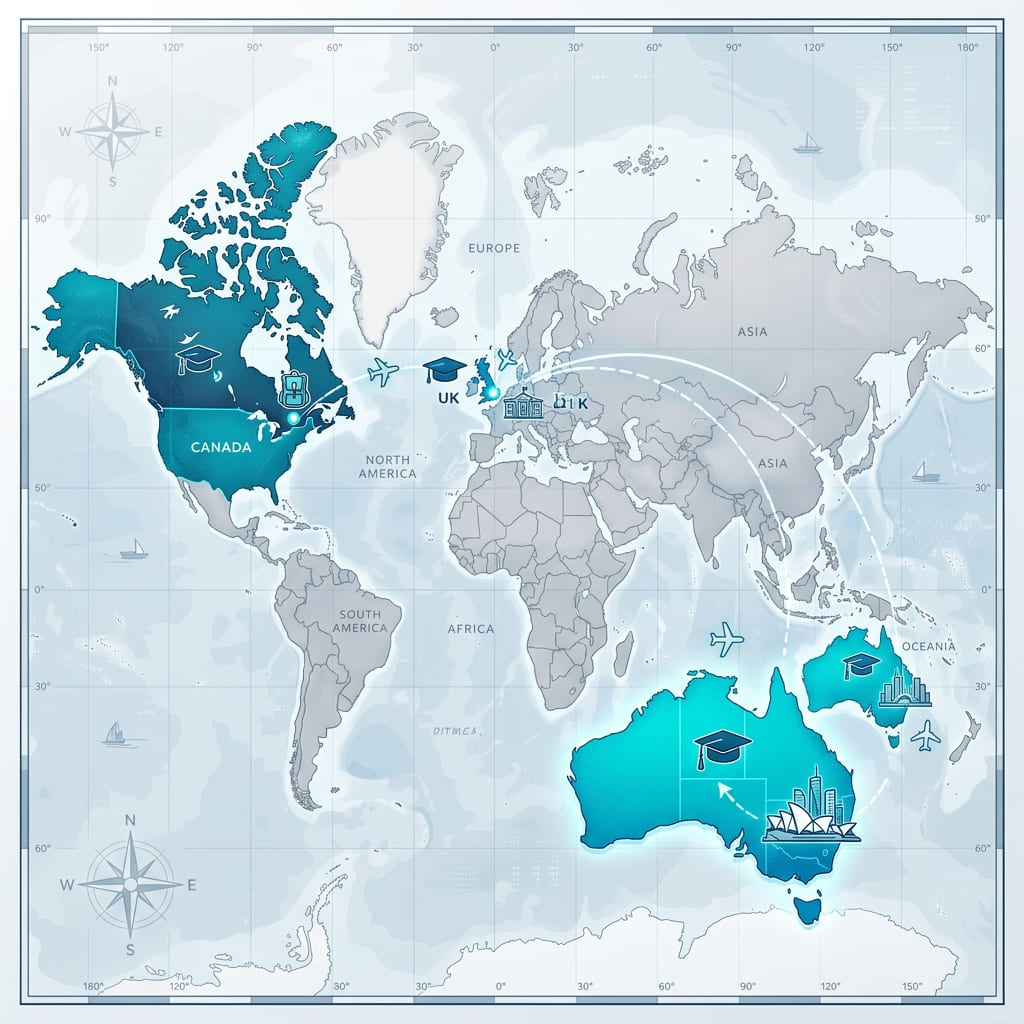
Core Differences Between IELTS and PTE
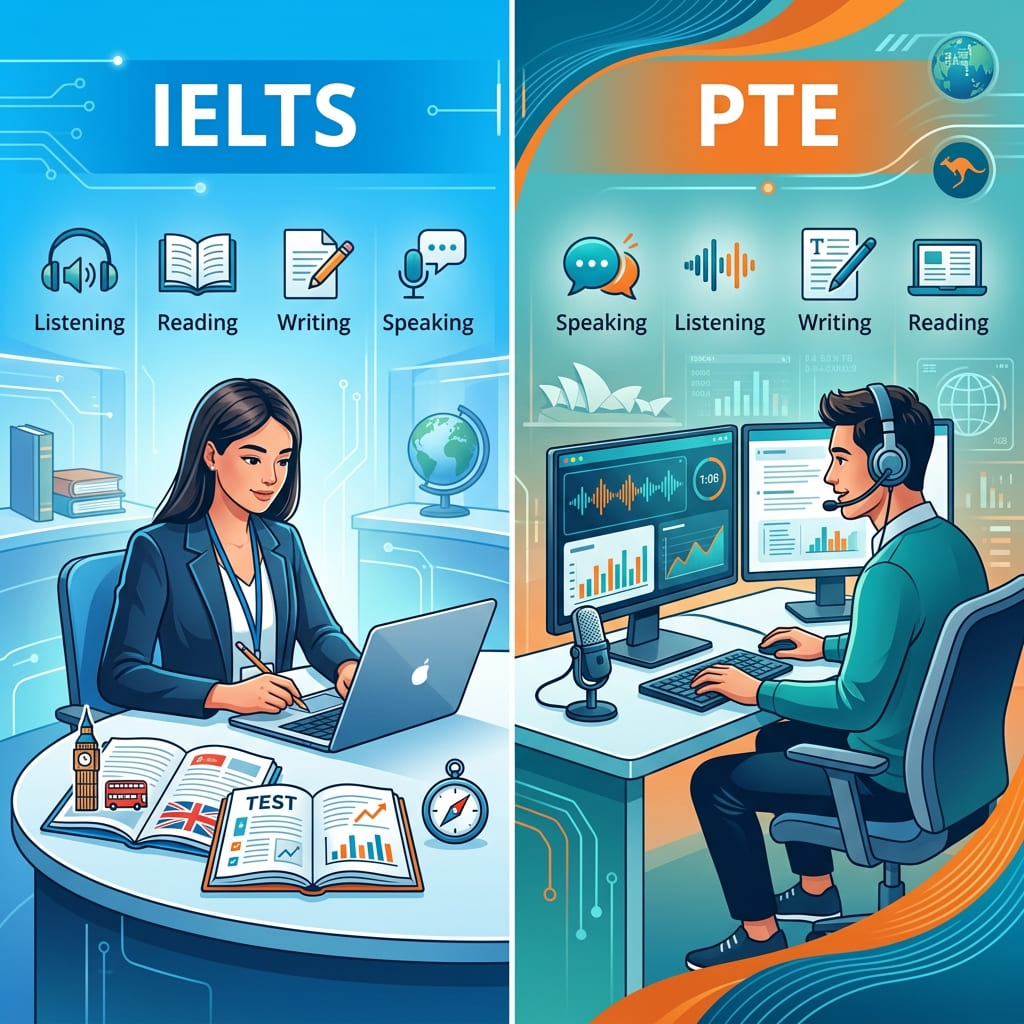
Before we look at specific country requirements, we need to establish how these two tests operate. Even though they both measure Reading, Writing, Listening, and Speaking, the experience of taking them is fundamentally different.
The IELTS Approach
IELTS offers two main versions for immigration and study: Academic and General Training. In 2026, the vast majority of IELTS exams are delivered via computer, though paper-based tests are still available in select regions.
The defining characteristic of IELTS is its human element. Even if you take the computer-based test, your Speaking section is conducted face-to-face with a real human examiner. For many students, talking to a real person reduces anxiety. For others, the pressure of a human evaluator is intimidating.
IELTS tasks are distinct and clearly separated. When you are in the Reading section, you are only graded on reading. When you are writing an essay, you are only graded on writing. This makes it easier to compartmentalize your study plan.
The PTE Academic Approach
PTE Academic is entirely computer-based and scored by artificial intelligence. There is no human examiner for the Speaking section. Instead, you speak into a microphone, and the AI evaluates your pronunciation, oral fluency, and content.
The most crucial difference is that PTE uses integrated scoring. A single task might test two skills simultaneously. For example, the "Read Aloud" task contributes points to both your Reading and your Speaking scores. The "Write from Dictation" task affects both your Listening and your Writing scores.
Because of this integrated scoring system, poor performance in one specific task type can drag down multiple section scores. However, students with strong technical English skills often find the AI grading system more objective and predictable than a human examiner.
Australia: Stricter Rules and Section Minimums
Australia has always been a top destination for skilled migrants and international students. In late 2025 and continuing through 2026, the Australian Department of Home Affairs tightened its grip on language testing regulations.
The End of At-Home Testing
If you are applying for an Australian visa, you must take your test at a physical, secure test center. During the pandemic, many providers introduced at-home versions of their tests, such as PTE Academic Online and IELTS Online.
In 2026, Australia does not accept these at-home versions for visa purposes. If you submit a score from an online, unproctored test, your visa application will be flagged and likely rejected. You must book an in-center exam.
PTE Component Scoring Changes
In the past, many nursing and engineering applicants favored the PTE because they could achieve a massive overall score that compensated for a weaker individual section.
Australia has closed this loophole. For specific skilled visas, the government now enforces strict minimums across all four components (Listening, Reading, Writing, and Speaking). If you need "Competent English" (equivalent to IELTS 6.0), you must hit the equivalent PTE score in every single section. You can no longer rely on a high Reading score to hide a low Speaking score.
The IELTS One Skill Retake Dilemma
IELTS recently introduced the One Skill Retake, allowing candidates to redo a single section of the test if they missed their target score.
While the Australian government does accept the One Skill Retake for many temporary and student visas, it is not universally accepted. Certain assessing authorities, particularly in the medical and engineering fields, explicitly reject the One Skill Retake for permanent residency skills assessments. Always check with your specific assessing body before relying on this feature.
Canada: The Rise of PTE Core
Canada operates on the Comprehensive Ranking System (CRS) for its Express Entry immigration pathways. To maximize your CRS points, you need to prove exceptional English proficiency, mapped to the Canadian Language Benchmark (CLB).
For years, IELTS General Training was the undisputed king of Canadian immigration. In 2026, the landscape has completely shifted with the introduction and widespread adoption of PTE Core.
Understanding PTE Core
PTE Core is a relatively new test specifically designed for Canadian economic immigration and citizenship. It is vital to understand that PTE Core is not the same as PTE Academic.
While PTE Academic uses university-level vocabulary and lectures, PTE Core focuses entirely on everyday, practical English. The tasks are similar, but the content revolves around writing emails to colleagues, listening to train announcements, and reading workplace memos.
If you are applying for Canadian Permanent Residency (PR) through Express Entry, you can now choose between IELTS General Training and PTE Core. Do not accidentally book PTE Academic, as it will not be accepted for standard economic migration routes.
IELTS General Training Remains a Powerhouse
Despite the introduction of PTE Core, IELTS General Training remains the most popular choice for Canadian applicants. The study materials are abundant, and the format is deeply familiar to language tutors worldwide.
If your goal is CLB 9 (which grants maximum immigration points), you need to achieve an IELTS score of 8.0 in Listening, and 7.0 in Reading, Writing, and Speaking.
One critical note for 2026: Immigration, Refugees and Citizenship Canada (IRCC) does not currently accept the IELTS One Skill Retake for Express Entry applications. You must achieve your required scores in a single sitting.
The United Kingdom: Strict SELT Requirements
The UK immigration system is notoriously rigid when it comes to English language testing. The Home Office operates a framework called Secure English Language Tests (SELT). If your test is not a SELT, it is useless for a UK visa application.
The "UKVI" Requirement
When you go to book your IELTS or PTE test for the UK, you will notice special versions labeled "IELTS for UKVI" and "PTE Academic UKVI."
The actual content, difficulty, and scoring of these UKVI tests are exactly the same as the standard versions. The only difference is the security protocol at the test center. UKVI tests require extra identity checks and continuous video recording during the exam.
If you take a standard IELTS Academic test, a UK university might accept it for admission, but the UK government will reject it for your Student Visa. You must ensure you select the UKVI option when booking.
PTE Core is Not Accepted
While PTE Core is making headlines in Canada, it holds no weight in the UK. The UK Home Office does not recognize PTE Core. If you are aiming for the UK, you must take PTE Academic UKVI or IELTS for UKVI.
For lower-level visa categories, such as the Spouse Visa or Sportsperson Visa, you might only need to prove A1 or B1 level speaking and listening skills. In these cases, you can take a simplified two-skills test, like IELTS Life Skills, rather than the full four-skills exam.

How to Choose the Right Test for You
Now that you understand the immigration rules, how do you actually decide between IELTS and PTE? The decision comes down to your personal strengths and your testing style.
Choose IELTS if:
You prefer speaking to a real human. If talking to a computer screen feels awkward and unnatural to you, the face-to-face IELTS Speaking test will be a much better experience.
You have messy handwriting but want to take a paper test. While the computer test is dominant, IELTS still offers paper options in some regions. If you are a slow typist, this might be your best route.
You struggle with integrated tasks. If you prefer to focus on one skill at a time without worrying that a bad reading performance will ruin your speaking score, the compartmentalized nature of IELTS is a safer bet.
You are applying for a Canadian study permit via the Student Direct Stream (SDS), as IELTS Academic is universally accepted.
Choose PTE if:
You have excellent pronunciation and technical fluency. The AI scoring system heavily rewards candidates who speak clearly, at a steady pace, without hesitations or filler words.
You type quickly and accurately. PTE requires you to type essays and short answers under strict time limits. Strong keyboard skills are an absolute necessity.
You want results instantly. While computer-based IELTS delivers results in a few days, PTE results often arrive within 24 to 48 hours. If you are facing a strict visa deadline, PTE is the fastest option.
You are aiming for Canadian Permanent Residency and prefer the practical, everyday English focus of the new PTE Core test over the traditional IELTS General Training.
Expert Preparation Strategies for 2026
Regardless of which test you choose, your preparation strategy must reflect the current realities of the 2026 exam formats. Relying on outdated advice from five years ago will severely hurt your chances.
Take Official Mock Tests
Do not rely solely on free YouTube videos or unverified practice materials. Both IELTS and Pearson offer highly accurate, official mock tests. Take at least two full-length, timed mock tests before your actual exam date. This will highlight your weaknesses and train your brain to handle the stamina required for a two-hour or three-hour exam.
Understand the Scoring Rubrics
The biggest mistake students make is writing beautiful essays that fail to answer the prompt. Both tests have strict scoring rubrics.
For IELTS, you are graded on Task Achievement, Coherence and Cohesion, Lexical Resource, and Grammatical Range. If you write a brilliant essay but fail to use paragraphs correctly, your Coherence score will plummet.
For PTE, the AI is highly sensitive to word count and format. If a task asks you to summarize a text in one single sentence, and you write two sentences separated by a full stop, you will score a zero for that task, no matter how good your grammar is.
Build Your Vocabulary Thematically
Do not try to memorize random lists of words from the dictionary. Both tests draw heavily from common academic and professional themes: the environment, technology, education, health, and urbanization.
When you learn a new word, learn its collocations (the words that naturally go with it). For example, do not just learn the word "environment." Learn phrases like "environmental degradation," "sustainable practices," and "ecological footprint." Using these natural combinations will boost your vocabulary score significantly on both tests.
Frequently Asked Questions (FAQ)
Can I mix and match scores from different test sittings?
No. For immigration purposes in Canada, Australia, and the UK, you must achieve your required scores in a single sitting (unless you are utilizing a specific, approved One Skill Retake option for an eligible Australian visa).
Is it true that the PTE Speaking AI cannot understand certain accents?
This is a persistent myth. The Pearson AI has been trained on thousands of accents from around the world. It does not penalize you for having an accent. However, it will penalize you for poor enunciation, speaking too softly, or unnatural pauses. Clarity and fluency are what matter most.
How long are my test scores valid for immigration?
Generally, IELTS and PTE scores are valid for two years for study purposes. However, for skilled migration visas in Australia and Canada, immigration authorities often accept scores that are up to three years old. Always check the specific rules of your visa subclass.
Can I switch from IELTS to PTE if I keep failing?
Yes. Many students who struggle with the IELTS Writing section switch to PTE and find success, while others who struggle with the fast pace of PTE Speaking switch to IELTS. Just remember that switching tests requires a completely new study strategy. You cannot apply IELTS tactics to a PTE exam.
Conclusion
Navigating the immigration landscape in 2026 requires careful planning. The days of simply taking a general English test and hoping for the best are over.
Whether you choose IELTS for its human touch or PTE for its rapid, AI-driven format, your success depends on understanding exactly what the governments of Canada, Australia, and the UK demand. Double-check your specific visa requirements, book the correct version of the test, and dedicate yourself to targeted, format-specific preparation. With the right strategy, you can secure the scores you need to start your new chapter abroad.